- Does Bid Map replace normal push dispatch?
- No — it runs alongside it. You choose which job types enter bidding (pre-bookings only is the common starting point); everything else continues through your existing dispatch flow. Bid Map is off by default, so enabling TaxiCloud changes nothing until you opt in from the dispatch settings screen.
- How is the winning bidder chosen?
- By a rule you configure per fleet. Closest bidder is the default — the passenger still gets the fastest realistic pickup. Fastest-finger awards the first bid received, and longest-waiting awards the driver who has been without a job longest, which suits fleets running rank or airport-queue fairness models.
- What do drivers actually see on the map?
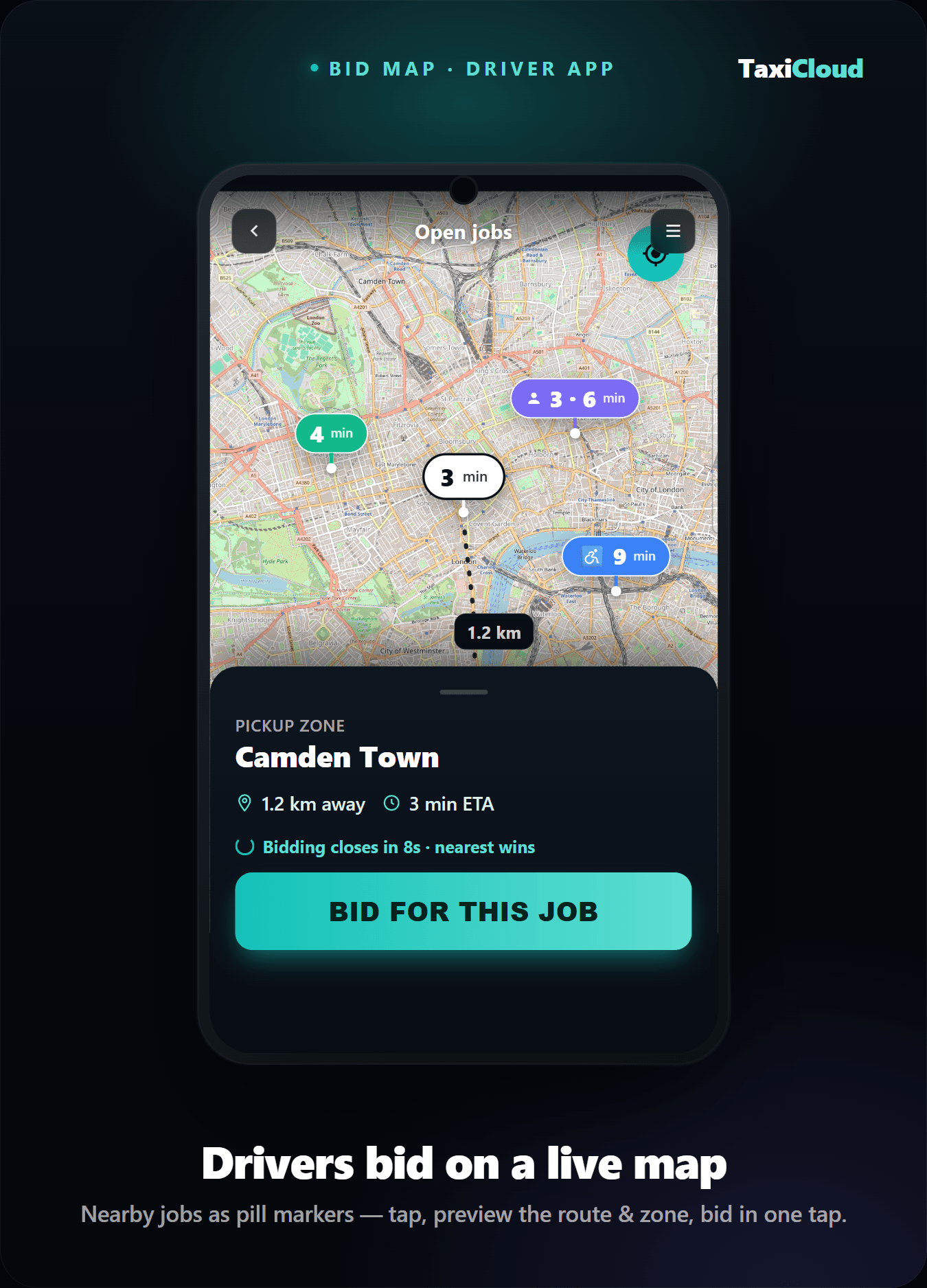
- Nearby pre-booked and open jobs render as pill markers showing ETA to pickup and passenger count. Wheelchair-accessible jobs carry a distinct marker so WAV drivers can find suitable work at a glance. Tapping a marker previews the route and pickup zone before the driver commits to a bid.
- Can drivers game the bidding window?
- The window is short — 5 to 15 seconds, configurable — and the allocation rule is deterministic, so there is nothing to camp on. Under the default closest-bidder rule, position wins, not reaction time. If you run fastest-finger, that is an explicit choice to reward attentiveness, and you can switch rules at any time without touching the driver app.
- Does Bid Map work on iOS as well as Android?
- Yes. Bid Map ships in both the Android driver app and the iOS driver app, with the same map markers, preview flow, and one-tap bidding on both platforms. Configuration is entirely server-side, so rule changes apply to every driver immediately without an app update.
- Will bidding slow down passenger pickup times?
- The bidding window adds at most 15 seconds before assignment, and in practice fleets recover more than that: because the winning driver chose the job, the decline-and-cascade cycle that push dispatch suffers largely disappears. Pre-bookings in particular get covered earlier, since drivers can see and claim upcoming work ahead of time.